
New Haven Estimated vs Actual Release
Connecticut Department of Correction uses specific date labels. Its published inmate-information field list includes minimum release date, maximum release date, and estimated release date. “Projected release date” is a common search phrase, but estimated release date is the safer term when that is what the CT DOC record shows. The estimate reflects the sentence and credit data then in the system.
An actual New Haven County release is a completed event. It may be a bond out, court discharge, end of sentence, parole release, transitional supervision placement, transfer, or another custody change. A scheduled date can pass without community release when a detainer, warrant, disciplinary issue, court order, or board decision intervenes. The public record may also update after the event.
New Haven Correctional Center primarily holds accused or unsentenced people. Their release may turn on bond, arraignment, dismissal, remand, or a new sentence, so no date calculation can replace the court docket. Cheshire Correctional Institution holds sentenced people, making sentence and CT DOC date fields more relevant.
Find a New Haven Projected Date
Begin with custody type. Connecticut has no New Haven County sheriff jail system. New Haven CC, Cheshire CI, Manson Youth Institution, and Bridgeport CC are CT DOC facilities, though they serve different roles. Short police or courthouse custody may never produce a CT DOC inmate record. Federal and ICE dates belong to separate systems.
- Identify the facility, arresting town, and court. New Haven CC serves several courts, while Bridgeport CC serves Ansonia, Derby, and Milford among others.
- Open the CT DOC Inmate Information Search. Search by inmate number when known, or use last name, first name, and date of birth.
- Match the date of birth, inmate number, status, and current location. Record the exact minimum, maximum, and estimated release labels shown.
- Check the sentencing docket for sentence length, time-served credit, later modifications, probation, special parole, and active warrants.
- Review BOPP records when parole is involved. A hearing date or parole-eligibility date is not an actual release date.
- Call CT DOC Public Information when the result is missing, stale, or unclear. Ask for current status and the public release-date fields.
The CT DOC search itself advises trying only the inmate number or the first few letters of the last name for a better match. A blank result does not confirm release. The person may be outside DOC custody, misidentified, transferred, not yet entered, or covered by a restricted record. For the full named-person verification route, use the New Haven County released-inmate lookup.
The official CT DOC inmate-search service page shows the state route used for both sentenced and pretrial DOC custody.
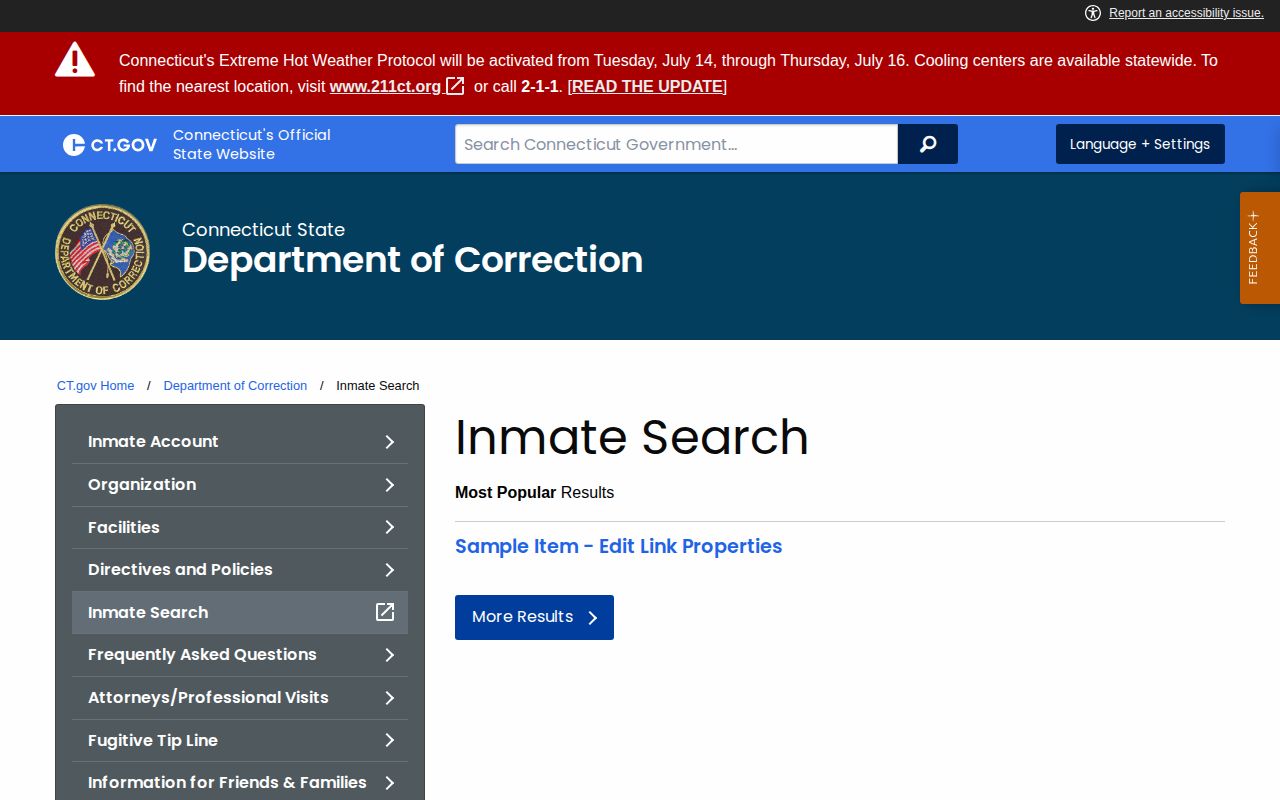
The service link leads to the public search, while detailed questions go to CT DOC Public Information.
Note: Use the exact CT DOC field name shown on the record rather than treating minimum, maximum, and estimated dates as interchangeable.
New Haven Earned-Credit Release Math
Connecticut's sentence calculations may include Risk Reduction Earned Credits under CGS Section 18-98e and the OLR sentence-reduction summary. Credits can affect a calculated date for an eligible sentenced person. Eligibility and application may depend on the offense, discipline, rules, and court decisions. Credits do not erase a detainer, warrant, or other legal hold.
Parole eligibility is another date, not the same as release. The OLR 2025 parole-law report summarizes the framework under Section 54-125a. For many hearing-required cases, a person generally must complete at least 75 percent of the sentence less applicable risk-reduction credits. Violent crimes, home invasion, or second-degree burglary generally use an 85 percent threshold less such credits. Listed serious offenses may be excluded from parole eligibility.
This percentage framework is often called truth in sentencing. It sets a parole-eligibility threshold for covered cases, while CT DOC's estimated release calculation and the parole board's actual decision remain separate steps.
Those percentages do not let a reader safely calculate one person's New Haven County release date. The sentence structure, controlling offense, jail credit, earned credits, board action, detainers, and later court orders all matter. CT DOC and BOPP must apply the law to the record.
Minimum and maximum dates also answer different questions. A minimum date may mark the earliest date allowed by the sentence calculation, while the maximum date reflects the outer term shown by DOC. The estimated date may incorporate credits and current administrative data. None of the three, standing alone, states that a parole panel granted release or that another agency has no hold.
- Estimated release date
- A CT DOC calculation based on data then in the record.
- Parole eligibility
- The point when a person may be considered under parole law, not a promise of release.
- Detainer
- A request or hold from another authority that can affect where the person goes next.
- Mittimus
- The court document committing a sentenced person to custody.
Why New Haven Release Dates Change
A New Haven County date can move because the underlying legal or custody record changes. CT DOC search snippets specifically warn that release dates may change with the application of Risk Reduction Earned Credits. Other events can alter the date or prevent community release even when the sentence calculation itself appears complete.
| Change | Effect on the release path | Where to verify |
|---|---|---|
| Earned-credit award or recalculation | May change the estimated date for an eligible sentence | CT DOC status and Public Information |
| Disciplinary action | May affect credit or placement decisions | CT DOC record or request |
| Sentence modification or jail credit | Changes the term or credit applied | Court docket and CT DOC |
| Parole grant, denial, or deferral | Changes whether and when community release may occur | BOPP decision and CT DOC |
| Detainer or warrant | May block release to the community or cause a transfer | CT DOC, court, and holding agency |
| Transfer to another jurisdiction | Ends one custody record but not all custody | Sending and receiving agencies |
“Released from CT DOC” may mean transfer to federal, immigration, another state or local authority, a community placement, or hospital custody. The next status matters as much as the date. Do not read the disappearance of a current facility as proof that the person walked into the community.
Confirm a New Haven Release
An estimated date becomes meaningful only when official sources confirm the event. Check the CT DOC record again near the date. Review the court docket for a bond change, sentence modification, probation order, dismissal, nolle, time served, or remand. If parole applies, compare the BOPP decision with the assigned Parole and Community Services office.
CT SAVIN and VINELink can provide custody-change alerts, but they are notification systems rather than full sentence ledgers. A release alert may not explain the court reason, each credit, or the next jurisdiction. The New Haven County VINELink check explains how to register and confirm alerts.
For direct help, CT DOC Public Information accepts inmate-status questions by phone at 860-692-7780 on weekdays from 8:00 a.m. to 4:30 p.m., and by mail at 24 Wolcott Hill Road, Wethersfield, CT 06109. Give the full name, date of birth, inmate number, facility, and the exact date field at issue.
Note: A notification confirms a custody change, but the court or CT DOC record is still needed to explain the release reason.
New Haven Pretrial Release Timing
A pretrial detainee at New Haven CC does not have a sentence-based projected release date. Physical custody may end when bond is posted, a judge changes conditions, the case is dismissed or nolled, the person receives time served, or the person is moved after sentencing. Each event is controlled by the court and DOC processing, not a county good-time schedule.
Find the court based on the arresting town and case. New Haven CC serves courts in New Haven, Meriden, Waterbury, Bantam, and Litchfield. Bridgeport Correctional Center serves Ansonia, Derby, and Milford courts among others, so a New Haven County case may appear there. Municipal police custody can also end before the person enters CT DOC.
The most reliable estimate is therefore event-based: check the next court date, bond status, docket entry, and current DOC status. Do not manufacture a date by subtracting credits from a sentence that has not been imposed.
A court docket can show why the estimate cannot yet be fixed. Bond may remain unmet, a case can continue, the court can impose a sentence equal to time served, or a new mittimus can send the person into sentenced DOC custody. Once that change occurs, the DOC record may gain sentence and release fields that did not apply while the case was pretrial.
Connecticut Release Computation Rules
Connecticut's state-run system is the key local quirk. New Haven County has no sheriff sentence calculator or county jail good-time formula. CT DOC and the sentencing court compute dates for correctional-center and prison custody. The same statewide system covers pretrial New Haven CC and sentenced Cheshire CI, but the records and legal triggers differ.
Risk Reduction Earned Credits and the 75 or 85 percent parole thresholds can affect timing, yet they operate in different ways. Credits may affect the calculated sentence date for an eligible person. A parole threshold marks when a hearing may become available. Neither overrides an exclusion, detainer, disciplinary change, warrant, board decision, or later court order.
For that reason, a calendar calculation should be treated only as a rough question to take to CT DOC, BOPP, or counsel. The official public record may show a minimum date, maximum date, and estimated date at once. Their coexistence reflects different legal limits, not an error.
When sources disagree, note when each record was checked. Court entries, DOC data, board decisions, and CT SAVIN alerts may post on different schedules. Ask CT DOC Public Information for the current official status and date labels instead of choosing the newest-looking result without knowing its source.
Note: Record the source and check date beside each release estimate because Connecticut court, DOC, board, and notification updates may post separately.