
New Haven Post-Release Supervision
CT DOC Division of Parole and Community Services supervises people released to the community under the jurisdiction of the Commissioner of Correction and the Connecticut Board of Pardons and Paroles. The division has district offices in New Haven, Waterbury, Bridgeport, Hartford, and Norwich, plus specialized units. The New Haven district is one local contact point for assigned cases.
It does not hold inmates. No one is released “from” the Grand Avenue office in the way a person leaves New Haven Correctional Center or Cheshire Correctional Institution. Instead, someone may report there after physical release or be assigned to a district team. The release record remains with CT DOC, the sentencing court, or BOPP, while the office handles the community-supervision phase.
Note: A supervision-office record begins after release and does not replace the correctional facility’s discharge or movement record.
New Haven Release Statuses
A person leaving CT DOC custody can have several next statuses. Parole is a conditional release approved through the parole process. Special parole is part of a court sentence that follows incarceration. Transitional supervision and community release are DOC pathways that may move a person into the community before final discharge. Probation is different because a court imposes it and the Judicial Branch supervises it.
| Status | Decision source | Local route |
|---|---|---|
| Parole | Board of Pardons and Paroles | Assigned CT DOC district |
| Special parole | Court sentence and DOC administration | Parole and Community Services |
| Transitional supervision | CT DOC | Assigned community-supervision unit |
| Community release | CT DOC program decision | District or specialized unit |
| Probation | Superior Court | Judicial Branch Adult Probation |
| No supervision | Sentence or case completion | No parole district reporting |
Read the exact status rather than using “parole” for every post-release arrangement. Calling the wrong agency can delay confirmation and may produce an apparent no-match even when a valid supervision record exists elsewhere.
Verify New Haven Supervision
Start with the CT DOC Inmate Information Search. Match the person by inmate number, name, date of birth, and other public identifiers. Note the current status, location, and release fields. If the record indicates release, check the decision or disposition that defines what follows. BOPP materials support parole decisions; a court docket supports probation or special-parole terms.
- Confirm the person’s identity in the CT DOC record.
- Identify the physical release or community-placement event.
- Read the BOPP decision or court sentence that created supervision.
- Determine whether the status is parole, special parole, DOC community supervision, or probation.
- Contact the assigned New Haven district only when the public record points there.
- Use DOC Public Information for unclear release or assignment records.
The district office may not provide private case details to any caller. Ask a narrow routing or public-status question and be ready with the CT DOC inmate number. For a released person whose status is unclear, the New Haven County release-record workflow shows how to compare custody, court, notification, and supervision records.
Note: A narrow status question with the CT DOC number is easier to route than a broad request for case details.
New Haven Supervision Contact
The official directions page lists the New Haven Parole and Community Services office at 620 Grand Avenue with a direct district phone and fax. Research sources displayed inconsistent ZIP information, so the street and city should be used while the current official page is checked for mailing details. Call before mailing a time-sensitive request.
New Haven Parole and Community Services620 Grand Avenue
New Haven, CT
Phone: 203-937-2400
Fax: 203-937-2414
Post-release supervision district
The official New Haven district directions page is the source for the location and contact numbers. The successful subject-matched screenshot appears below.
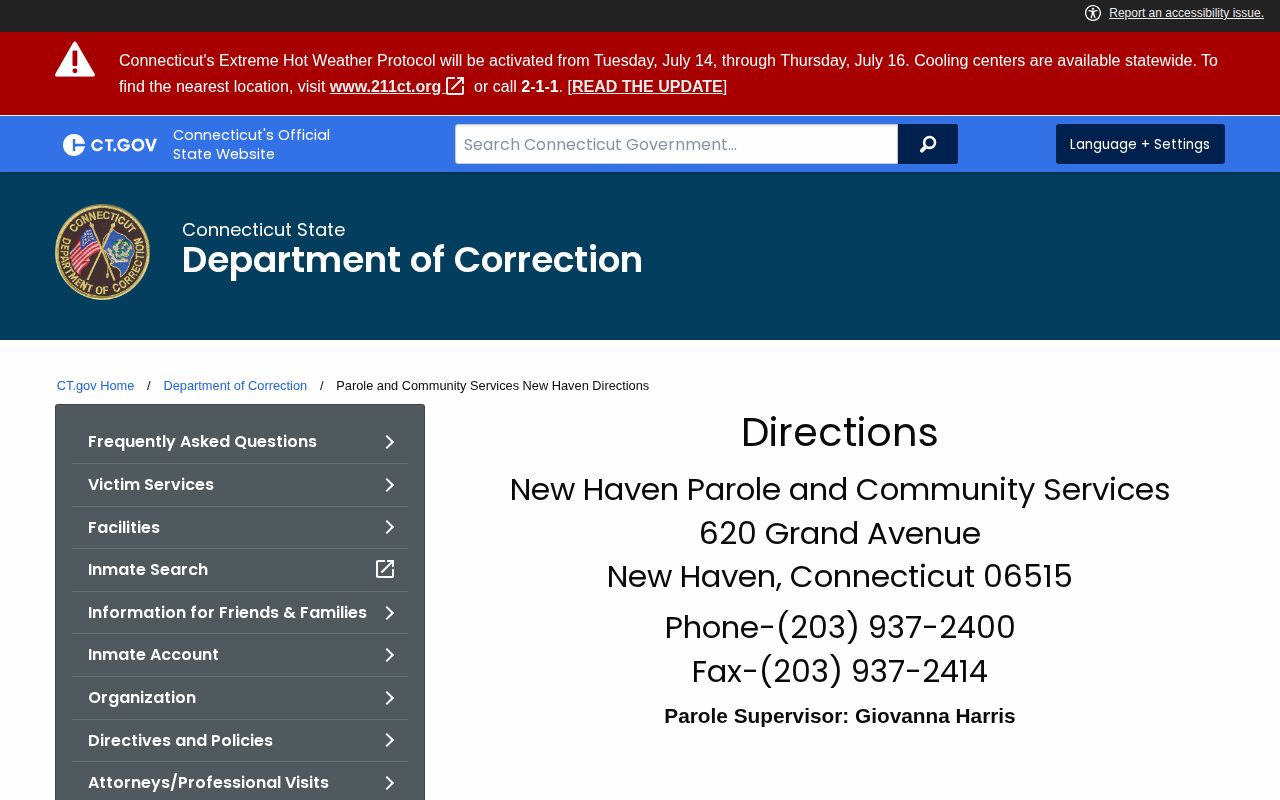
The page confirms a supervision office, not a custody facility. Release records should still be requested from CT DOC, BOPP, or the court that created them.
New Haven Supervision Records
A supervision inquiry should separate the release record from the active case record. CT DOC Public Information can address the custody exit and movement. BOPP can provide parole hearing or decision context and accepts certain hearing-record requests through its official process. The district office may hold supervision records, but access can be limited by privacy, safety, investigative, and other public-record exemptions.
| Needed fact | Likely record holder |
|---|---|
| Actual DOC release date | CT DOC Public Information |
| Parole decision | Connecticut BOPP |
| Court-imposed probation | Judicial Branch court and Adult Probation |
| Assigned parole district | CT DOC Parole and Community Services |
| Custody-change notification | CT SAVIN or VINELink |
| Absconder enforcement record | Official supervision or warrant channel |
For a public-record request, provide the person’s name, birth date, CT DOC number, supervision type, approximate release date, and exact document sought. Ask for an electronic copy and fee estimate. Avoid requesting sensitive home, victim, medical, treatment, or safety information that the agency cannot lawfully release.
New Haven Parole Decisions
The Connecticut Board of Pardons and Paroles makes parole-release decisions and publishes hearing information. It is not the supervising district. A listed hearing proves only that a matter was scheduled. The panel may grant, deny, continue, or otherwise decide the case, and CT DOC must then carry out the resulting custody action.
To confirm parole, match the person and hearing information to the official decision, then compare that result with CT DOC status. Finally, confirm the assigned supervision route. This sequence prevents a scheduled hearing from being mistaken for a completed release.
- Eligibility
- The point when a person may be considered under applicable parole rules.
- Hearing
- The Board’s review proceeding; it is not itself a release.
- Decision
- The Board’s official action after review.
- Discharge
- The formal end of the identified custody or supervision status.
New Haven Absconder Records
CT DOC identifies Fugitive Investigations among the Parole and Community Services units. An absconder or supervision fugitive is someone who was released to a supervision status and is alleged to have failed to report, left an authorized placement, or otherwise could not be located under the applicable rules. That is not the same as an ordinary completed release.
Do not infer absconder status from a missed appointment, rumor, or an old custody record. Use an official supervision, warrant, or law-enforcement channel. Public details may be limited because an active investigation or safety concern is involved. If immediate danger exists, use emergency services rather than a records office.
CT SAVIN notifications can include escape, absconding, and return-to-custody events in participating systems. An alert is a signal to verify the official status, not a full enforcement record.
Note: Absconder status concerns compliance after release and is not proof that the person remained in the original jail.
New Haven District Routing
New Haven County also has a relevant Parole and Community Services office in Waterbury. The assigned district depends on the supervision plan and area, not only the prison from which a person left. Someone released from Cheshire CI may report to New Haven, Waterbury, or another district. A person held at New Haven CC may instead receive court probation and never enter DOC parole supervision.
The statewide Parole and Community Services page lists district offices and specialized functions such as Residential Services, Central Intake, Special Management, Mental Health, Fugitive Investigations, DUI, Women’s Re-Entry, Support Services, and Training. These are operational routes, not a public list of every released person.
Have the official release status in hand before contacting a district. That small step reduces misrouting and keeps the inquiry focused on a fact the office can address.
New Haven Supervision Discharge
Release from a correctional institution and discharge from supervision are separate events. A person can be out of a cell yet remain on parole, special parole, transitional supervision, or another community status. The physical release date marks the custody change. The supervision-discharge date marks the end of the later status, if the person completes it without another controlling event.
To verify the end of supervision, use the agency that administered it. For parole-related status, begin with CT DOC and BOPP records, then ask the district about the correct public-record channel. For probation, use the sentencing court and Judicial Branch. A completed sentence field does not automatically explain a separate special-parole term, and an old district assignment does not prove that supervision remains active today.
Revocation or return to custody can interrupt the sequence. CT SAVIN may alert a registrant to a return-to-custody event, but the official DOC or court record explains the authority for it. Ask for dates and status labels rather than informal conclusions. That produces a clean timeline: institutional release, assigned supervision, any intervening change, and final discharge.
A district transfer can change the reporting office without ending supervision. Confirm the effective date and receiving district before concluding that New Haven closed the case.