
No New Haven 72-Hour Feed
No official New Haven County 72-hour sheriff release roster was found. Connecticut does not use the ordinary county-jail model. CT DOC runs correctional centers, courts control many pretrial exits, and municipal police can release a person before any DOC record exists. As a result, there is no county list that can be filtered to three days.
The absence changes the task. A three-day review must ask which facility or agency had custody, which court handled the case, when each source updated, and whether the event was a release at all. New Haven Correctional Center serves several Superior Courts. Bridgeport Correctional Center also matters for Ansonia, Derby, and Milford cases. Cheshire Correctional Institution and Manson Youth Institution are state institutions with different release trails.
Town and court location can narrow the search. New Haven and Meriden matters may point toward New Haven Correctional Center. Ansonia, Derby, and Milford matters may involve Bridgeport Correctional Center. Waterbury questions can require both the court and the state correctional path. That routing fact is more useful than searching the same county phrase on three different days.
Note: A three-day review is a comparison window, not an official New Haven County roster or guaranteed retention period.
Review Three Days of Releases
Work from the start of the suspected three-day window through the current day. Record each source's date and status. This avoids treating an old court event as a new release or a recent transfer as a community discharge. Use exact identifiers, especially an inmate number or docket number.
- Search the CT DOC Inmate Information Search and note the person's status, location, inmate number, and any release fields.
- Check Connecticut VINE or CT SAVIN for current custody status and notifications received during the window.
- Review the court docket for bond, discharge, nolle, dismissal, sentence served, probation, or remand entries on each date.
- Ask the facility or DOC Public Information whether the event was release, transfer, community placement, death, or return to custody.
- Use a written records request if no online source states the event and date clearly.
The New Haven County 24-Hour Release List workflow is better for an event known to have happened today. A three-day review is meant to reconcile several days, not replace a same-day call.
New Haven Three-Day Record Fields
There are no county-published fields, cadence rules, or retention rules for a 72-hour list. The most useful substitute is a small event record built from official sources. It should identify the person, the prior custody site, the event date, the type of movement, and the next status. Missing facts should stay marked as unconfirmed.
| Field | Three-day use |
|---|---|
| Full name and identifiers | Matches CT DOC, VINE, court, and records responses. |
| Facility before event | Separates New Haven CC, Bridgeport CC, state prison, police, federal, and ICE paths. |
| Event date and time | Places the movement inside the 72-hour span when available. |
| Release or movement type | Distinguishes bond, discharge, sentence end, parole, transfer, death, and return to custody. |
| Court disposition | Explains the order behind a pretrial or sentence-related exit. |
| Next status | Shows freedom from custody, supervision, community placement, or another agency hold. |
A release record can be a cluster of records, not one form. CT DOC status may supply the custody fact, while the docket explains the legal event and a supervision office confirms what followed.
New Haven Weekend Release Review
A three-day span is most useful when a court event, DOC movement, and online update fall on different days. It can catch a Friday event reviewed after the weekend, or a release that was processed before a public system changed. Research found no county rule that promises updates on a fixed schedule. Avoid calling the window live or complete.
Use a simple dated log. Write down when CT DOC was checked, which status appeared, which court entry was reviewed, and whether a VINE notice arrived. If a later source changes, preserve the earlier result and compare the event dates. This makes it easier to explain why a Friday court discharge may not look the same as a Monday status check.
Start with the date of the court order, then check the date DOC reports the custody change. Those dates may answer different questions. The court can authorize release, while the correctional record shows when physical custody ended. A detainer, warrant, transfer order, or property process can also keep the actual exit from matching the first docket entry.
The official Judicial Branch docket-number search supports a case-specific review.
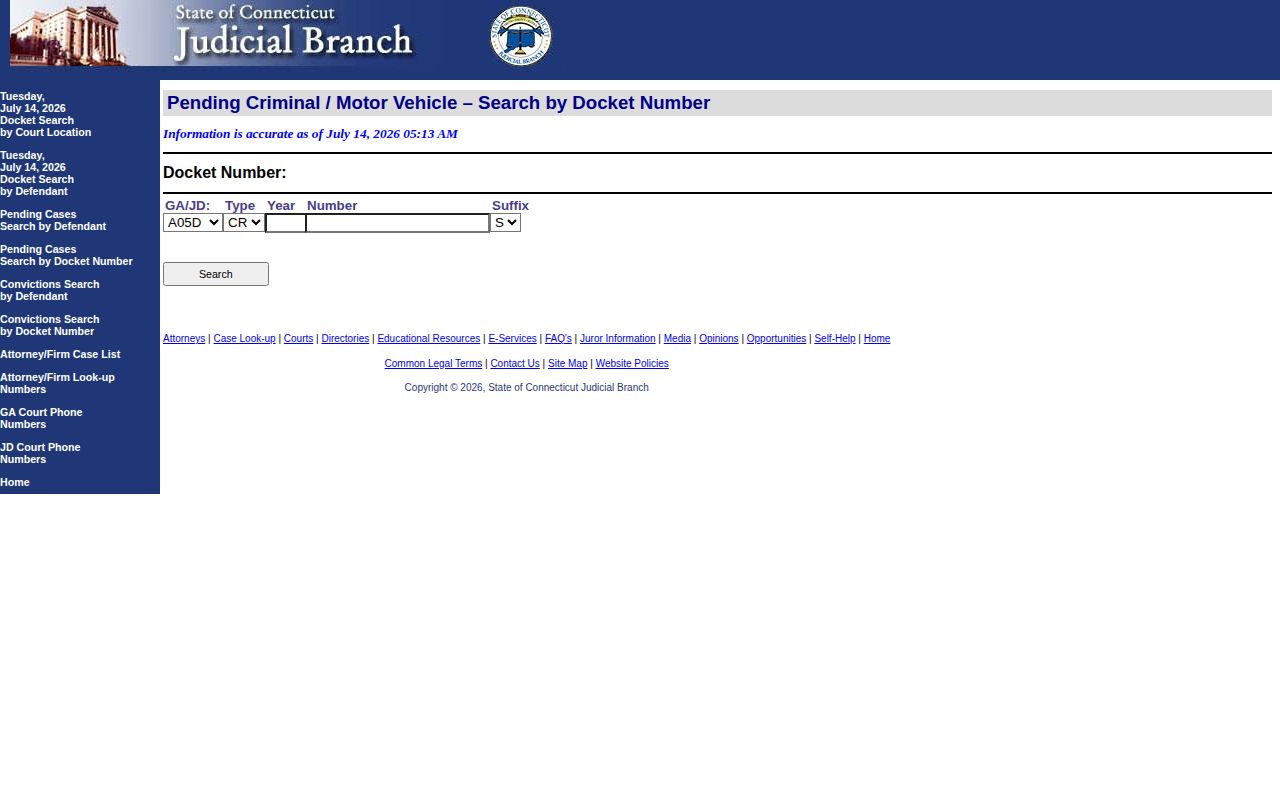
Use that docket trail with CT DOC status. A pending case page alone does not prove whether a person has left a correctional center.
Note: Weekend and holiday timing can delay comparison across systems, so confirm the physical release with the holding agency when timing matters.
New Haven Roster Absence Explained
The key data quirk is structural. New Haven County has no sheriff jail system and no official mobile app that posts three-day releases. CT DOC handles state correctional custody. Superior Courts handle many bond, discharge, and sentencing decisions. Police and court cells may hold people briefly without creating a county roster entry.
This means a person can be released in New Haven County and never appear in a county feed. Someone released by a municipal police department on a promise to appear, bond, summons, or court order may need to be traced through the arresting agency and docket. A person transferred from New Haven CC to another facility has left that center but has not left custody.
Likewise, a person at Cheshire Correctional Institution follows a state-prison discharge path. CT DOC release fields, CT SAVIN alerts, parole-board action, and Parole and Community Services may matter more than the local court. The source must match the custody type.
A federal sentence follows another trail. The Federal Bureau of Prisons locator can report former federal custody and a release date, while CT DOC may have no matching record. ICE custody is also separate. The Online Detainee Locator System is mainly a current-custody tool, so a release may require the field office or an attorney to confirm. Neither event belongs on a New Haven sheriff list.
Request New Haven Release Records
Use a written request when the online record does not identify the reason or date. Provide the full name, date of birth, CT DOC inmate number, docket number, facility, arresting agency, approximate custody dates, and the exact record sought. Ask for the release or movement record and, when useful, the business-day processing date.
The CT DOC Public Information Office takes inmate-status questions at 860-692-7780, Monday through Friday from 8:00 a.m. to 4:30 p.m. Written mail goes to CT DOC Public Information Office, 24 Wolcott Hill Road, Wethersfield, CT 06109. A facility may route detailed requests there.
Ask whether the event was bond out, court discharge, sentence completion, parole, transitional supervision, community release, transfer, death, or return to custody. If the person never entered DOC custody, send the request to the arresting police agency or the Judicial Branch record source instead.
Requests should be narrow. Ask for the nonexempt release, discharge, or movement record for the named person and date range. An electronic copy may be easier to review. Connecticut public-record fees and exemptions depend on the agency and record, so request a fee estimate and do not assume every youth, sealed, erased, or protected record will be released.
If the agency returns a movement history, read each entry in order. An exit from one facility may be followed by entry at another facility on the same day. That sequence shows transfer, not release. A true community exit should be checked for parole, probation, transitional supervision, or another post-release status before the record is described as a full discharge.
Note: Ask for the release reason and receiving authority together so a transfer is not mistaken for community release.
Confirm the New Haven Outcome
A three-day record review is complete only when the event and next status agree. A current CT DOC location means the person remains in state custody. Release or discharge language should be paired with the court record when the case was pretrial. A parole or community-release event may place the person under supervision even though physical custody ended.
| Source result | What to do next |
|---|---|
| Current correctional location | Confirm custody with CT DOC or the listed facility. |
| Release or discharge status | Match the date and event to court, VINE, or records response. |
| No CT DOC result | Check spelling, police, court, BOP, ICE, and restricted-record possibilities. |
| Parole or community placement | Use BOPP and CT DOC Parole and Community Services. |
| Transfer | Locate the receiving agency before describing the person as released. |
For one named person whose route is still uncertain, the New Haven County release search and records coverage separates county-facing, state, federal, and immigration paths.