
Understanding New Haven County Releases
New Haven County has no county government that runs a sheriff jail. Connecticut Department of Correction facilities perform the work that a county jail and a state prison would split elsewhere. New Haven Correctional Center mainly holds accused, pretrial people. Cheshire Correctional Institution and Manson Youth Institution are state institutions, while Bridgeport Correctional Center serves some courts tied to Ansonia, Derby, and Milford. A person who leaves one of these settings may be released to the community, sent to supervision, or transferred to another authority.
That structure changes the meaning of a missing roster entry. It may reflect bond, discharge from court, a completed sentence, parole, transitional supervision, transfer, death, or a restricted record. It does not prove that a person walked free. The sound rule is to confirm the custody event and then confirm the next legal status through CT DOC, the court, CT SAVIN, the Board of Pardons and Paroles, or the agency that received the person.
Why New Haven County Releases Matter
CT DOC transitional services states that more than 95 percent of offenders eventually return to the community. That is statewide context, not a count of New Haven County releases. It shows why discharge status, reentry, court follow-up, and supervision records are central parts of a custody search rather than rare exceptions.
The number does not predict a date or result for one person. Release still depends on the sentence, court orders, credits, board action, detainers, and other facts in that person's official record.
Note: The statewide percentage describes eventual return to the community, not the timing or outcome of any New Haven County release.
New Haven County Release Types
A release label should be read with the court case and facility record. Bond ends physical detention while the case continues. Time served means the imposed term is satisfied by custody already completed. A court may dismiss or nolle a charge, impose probation, order a conditional discharge, or remand the person. A sentenced prisoner may reach end of sentence, gain parole approval, enter transitional supervision, or move to a community placement.
| Event | Meaning | Next record |
|---|---|---|
| Bond out | Physical custody ends under court-set conditions | Court docket and CT SAVIN notice |
| Court discharge | A court event ends the hold | Disposition or sentencing docket |
| Sentence completion | The custodial term reaches its end | CT DOC status and discharge response |
| Parole or community release | Custody changes to supervised community status | BOPP decision and Parole Services |
| Transfer or detainer | Another agency takes custody | Receiving state, BOP, or ICE system |
- Discharge
- The end of a custody status or legal obligation identified by the issuing agency.
- Time served
- A sentence satisfied by time already spent in custody.
- Detainer
- A request or legal hold that may send a person to another authority instead of the community.
- Remand
- A court order returning or committing a person to custody.
Note: A transfer ends custody at one facility but does not mean the person entered the New Haven County community.
New Haven County Bond Releases
Bond release is a court and CT DOC event, not a sheriff roster event in New Haven County. The CT DOC Victim Services Unit lists both bond out from a correctional facility and discharge from court among the accused-status changes for which notifications may be available. The court docket remains vital because it can show a bond change, a posted bond, a promise to appear, a nolle, dismissal, or another order that explains why detention ended.
A bond release does not resolve the underlying case. It only changes custody. Compare the CT DOC status with the docket for the court that handled the arrest. If the person was released by municipal police and never entered DOC custody, ask the arresting police agency for its public arrest or release record. New Haven County has no single records desk that combines these municipal events.
Read New Haven County Release Records
A Connecticut release record is a set of linked records rather than one standard form. Its useful core identifies the person, facility, custody status, event, date, and next status. A CT DOC response may add sentence fields, movement history, a detainer notation, correctional history, or a photograph. A court docket may supply the disposition that caused the change. A supervision office may confirm that physical release led to parole or another community status.
| Field | What it establishes |
|---|---|
| Name, birth date, inmate number | Matches the event to the right person |
| Facility and admission date | Shows which agency held the person |
| Release date and event | Identifies when and how custody changed |
| Transfer or detainer | Shows whether another authority took custody |
| Sentence and estimated dates | Explains a sentenced prisoner's calculated range |
| Supervision status | Identifies parole, probation, or community oversight |
| Court docket and disposition | Ties release to the controlling court event |
Can a person be released but still under control? Yes. Parole, probation, special parole, transitional supervision, and federal supervised release can follow physical custody. Transfer to another agency is not community release.
Note: Match identifiers across sources because a shared name alone cannot tie a New Haven County release record to one person.
Request New Haven County Release Records
The CT DOC Public Information Office is the main state route when a public search is incomplete. Identify the person and ask for the exact nonexempt record needed. New Haven Correctional Center may help route a recent facility question, but formal release, movement, discharge, or photo records usually run through CT DOC public-information or freedom-of-information channels.
- Provide the full name, birth date, CT DOC number if known, facility, and approximate custody dates.
- Name the records: release date and reason, movement history, discharge document, detainer notation, or booking photograph.
- Ask for electronic copies and a fee estimate. Connecticut law permits some copy and certification charges.
- Request the statutory basis for any withheld part and ask for all separable nonexempt portions.
- Compare the response with the court docket and any custody-change notice.
24 Wolcott Hill Road
Wethersfield, CT 06109
860-692-7780
Monday-Friday, 8:00 a.m.-4:30 p.m.
Connecticut General Statutes Section 1-212 allows requests for plain, electronic, facsimile, or certified copies. The statute permits prepayment when estimated fees reach $10 or more and sets a 50-cent page cap for covered non-state public agencies. State-agency charges may follow different terms, so request an estimate. No fixed CT DOC response time was documented in the research. Processing depends on the request, the record, and any needed exemption review.
New Haven County Record Limits
Connecticut's Freedom of Information Act begins with access to nonexempt records maintained by public agencies. Sections 1-210 through 1-212 address inspection, computer-stored data, copies, and fees. Access is not absolute. Safety, medical, victim, active-investigation, juvenile, youthful-offender, sealed, and erased-record rules can limit what an agency releases.
Chapter 961a governs criminal-record erasure and nonconviction information. Dismissals, not-guilty findings, nolles under stated conditions, and eligible Clean Slate matters can change public availability. A record that vanishes may also reflect a spelling error, limited retention, delayed data, or a transfer. No-result should never be recast as proof of release or proof that custody never occurred.
Note: Connecticut access rules can withhold part of a New Haven County release file while leaving other portions open.
Erased New Haven County Release Records
Clean Slate Connecticut describes automatic erasure for certain eligible older or lower-level records and cannabis matters. CTLawHelp also explains public routes for record clearing and pardons. Once a record is legally erased, agencies may be barred from disclosing it. That can remove the court or custody trail a released-inmate search would otherwise use.
Restrictions are especially important for Manson Youth Institution and any youthful-offender matter. Public visibility depends on the person's legal status and the record custodian. Use neutral wording in a request, and do not ask an office to reveal a record that law treats as erased. A missing public result can be a lawful outcome.
Find New Haven County Released Inmates
Start with custody type, not the county label. State DOC custody, brief police or court holding, federal custody, and ICE detention have separate systems. A former New Haven Correctional Center detainee belongs in the CT DOC and state-court path. A sentenced federal prisoner belongs in the BOP locator. Someone held only by police may never appear in the state inmate search.
- Search CT DOC by inmate number, or use the name and birth date.
- Match the facility and status. A current location means the person remains in DOC custody.
- Check the correct court docket for bond, disposition, sentencing, probation, or warrant activity.
- Use CT SAVIN/VINELink for current custody status and future change notices.
- Check parole or probation channels when release may have led to supervision.
- Use BOP or ICE tools only for their distinct federal custody systems.
- Request the release record when online sources are stale, missing, or unclear.
The New Haven County 24-hour release workflow addresses very recent events, where online updates may lag.
Note: A no-result CT DOC search requires follow-up and never proves that a New Haven County inmate was released.
Search CT DOC Release Records
The CT DOC Inmate Information Search is the first online source for a person who entered Connecticut correctional custody. The search advises using an inmate number alone or the first few letters of a last name for broader results. Match carefully. Similar names are common, and no result does not confirm release.
| Search or result field | How to use it |
|---|---|
| CT DOC inmate number | Best unique search key when known |
| Last and first name | Try variants or a partial last name |
| Date of birth | Separates people with similar names |
| Status and current location | Shows present CT DOC custody when listed |
| Admission and sentencing dates | Place the record in its case timeline |
| Minimum, maximum, estimated release | Planning dates that may change |
| Detainer and movement history | May explain a transfer instead of community release |
The official CT DOC field inventory shows why the result is more than a location check. Status, sentence dates, release estimates, detainers, photographs, and correctional history may each answer a different part of the New Haven County release question.
Route New Haven County Release Searches
The arresting town and court are better routing clues than the county name alone. CT DOC says New Haven Correctional Center serves courts in Meriden, New Haven, Bantam, Litchfield, and Waterbury. Bridgeport Correctional Center serves Ansonia, Derby, and Milford courts among others. A Milford case can therefore create custody activity at Bridgeport rather than New Haven.
Check the Connecticut Judicial Branch criminal and motor-vehicle docket for the court tied to the case. It may show bond, a nolle, dismissal, time served, probation, conditional discharge, a sentence, or a failure-to-appear warrant. These entries explain why a person left physical custody better than a bare no-result screen.
The official Judicial Branch criminal and motor-vehicle search provides the court-side path.
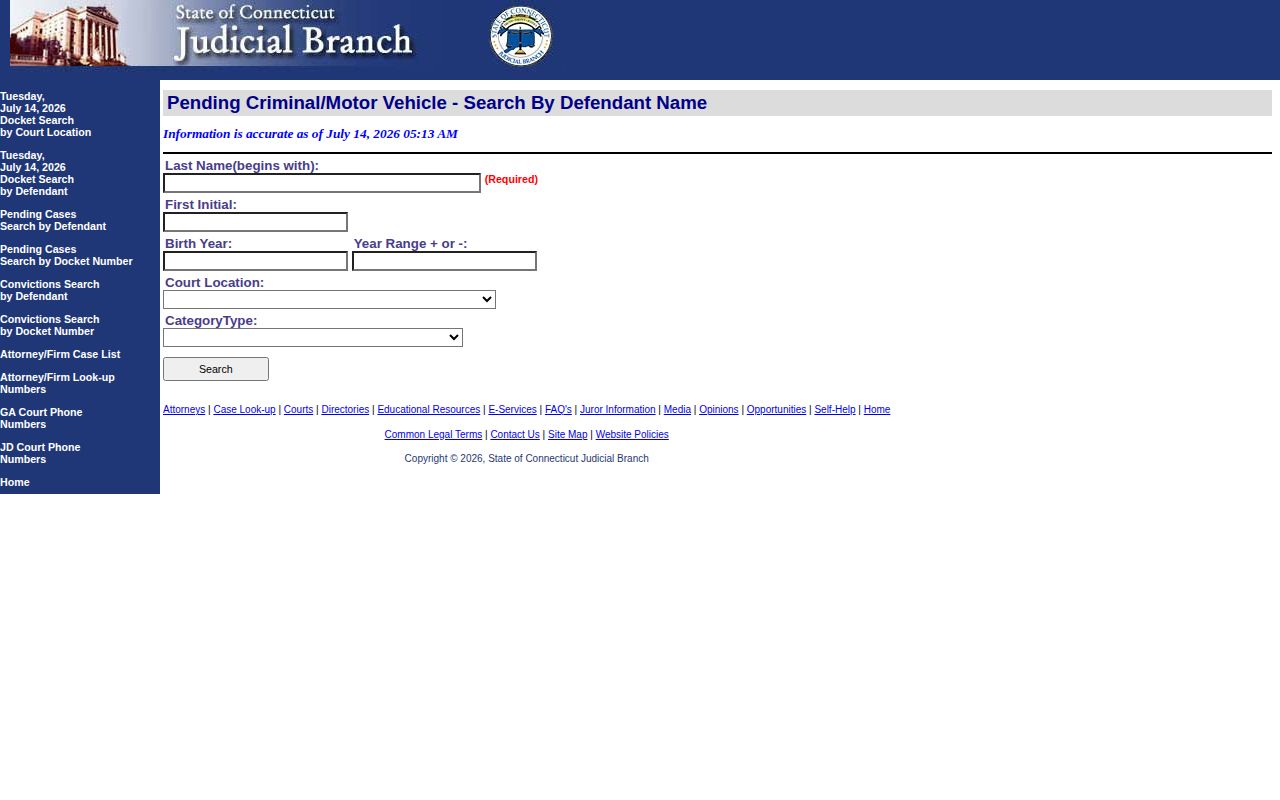
A docket should be matched to the person and case number before drawing any conclusion about custody.
No New Haven County Release Roster
No official New Haven County sheriff 24-hour or 72-hour release feed was found. That is a result of Connecticut's state-run correction system, not a missing link. CT DOC search, CT SAVIN, court dockets, the facility, and written requests replace the rolling county roster used in many other states.
Recent events can lag. A court may order release before the custody system updates, or DOC may show a transfer without the full reason. For a same-day question, save the identifiers, check both DOC and court status, and call the Public Information Office or facility. For a three-day window, repeat those checks and request the event record if the release reason remains unclear.
Where New Haven County Releases Occur
CT DOC directions for New Haven Correctional Center place it at 245 Whalley Avenue behind the juvenile facility, with access described from the Whalley, Orchard, and County Street approaches. That is useful for pickup planning, but it does not identify a public release door or guarantee a release time. Confirm the event before traveling and follow current facility directions.
A transfer changes the destination. Someone leaving New Haven CC may go to another CT DOC institution, court custody, a community placement, federal custody, ICE, a hospital setting, or supervision. Ask the record custodian whether the event was community release, court discharge, or agency transfer.
Getting Home After New Haven County Release
New Haven CC sits on the Whalley Avenue corridor. CTtransit local service and Route 243 can help with a trip toward downtown and New Haven Green connections. Schedules change, so use the current trip planner rather than an old printed time.
Release-day transport may also run through a reentry service for an enrolled person. A family pickup and a program-arranged trip are different plans. Confirm with the facility or reentry counselor before setting either one.
Note: Current transit schedules and a confirmed New Haven County release should guide travel plans, not an estimated custody date.
Verify New Haven County Release Supervision
Parole is supervised release from a prison sentence under the state parole framework. Probation is court-ordered community supervision, often after physical custody ends or instead of a jail term. The Board of Pardons and Paroles handles parole decisions, while CT DOC Parole and Community Services supervises people under its community authority. Adult Probation is a Judicial Branch function.
New Haven County has relevant Parole and Community Services offices in New Haven and Waterbury. Verify the correct district with the supervising agency. A person can be released and later be listed as an absconder or face a violation warrant, which is different from remaining in the original jail. The detailed New Haven County parole and probation process explains the two systems and local offices.
New Haven County Release Reentry
The City of New Haven maintains a Reentry Resource Guide that points to Project MORE's Reentry Welcome Center. Project MORE works with people on parole, probation, bail, and those leaving correctional facilities. This local layer matters because a confirmed release may lead to a reentry intake, case manager, or supervision office rather than a jail record.
CT DOC says every facility has a full-time reentry counselor, and its transitional services cover release planning. Ask about program enrollment before the release day. Public reentry listings can help locate support, but they do not confirm that a specific person has been discharged.
New Haven County Release Papers
Discharge papers, DOC documents, identification, court orders, and supervision instructions help establish what happened next. New Haven's reentry guidance tells people to gather available identification and discharge or DOC papers for intake. Staff may start replacement requests when an item is missing.
Keep the papers distinct. A release form documents a custody event. A court disposition states what happened in the case. A parole or probation instruction identifies reporting duties. None should be assumed to replace the others. When requesting a missing record, give the facility, date range, inmate number, and docket number so the custodian can locate the right file.
Note: Keep the New Haven County release record, court disposition, and supervision instructions as three separate official documents.
New Haven County Release Notifications
Connecticut VINE and CT SAVIN support custody and court notifications. The state brochure says users may need separate registrations for DOC custody changes and criminal court events. VINE is a status and alert layer, not a historical release record. It should be checked against CT DOC and the docket.
Federal and immigration custody use other systems. The BOP Inmate Locator can show a former federal inmate's release date or that the person is not in BOP custody. The ICE Online Detainee Locator System is mainly a current-detention locator. A state release followed by a detainer may mean transfer to federal or immigration custody rather than a walk into the community.
A separate public path applies to people required to register after release. The DESPP Sex Offender Registry may show a last known address, physical description, and offense details. It is a registry, not proof of current jail custody. Connecticut also has a deadly-weapon registration program, but the research found conflicting descriptions of public access, so it should not be treated as an open release lookup.
The BOP locator illustrates the separate federal search route.
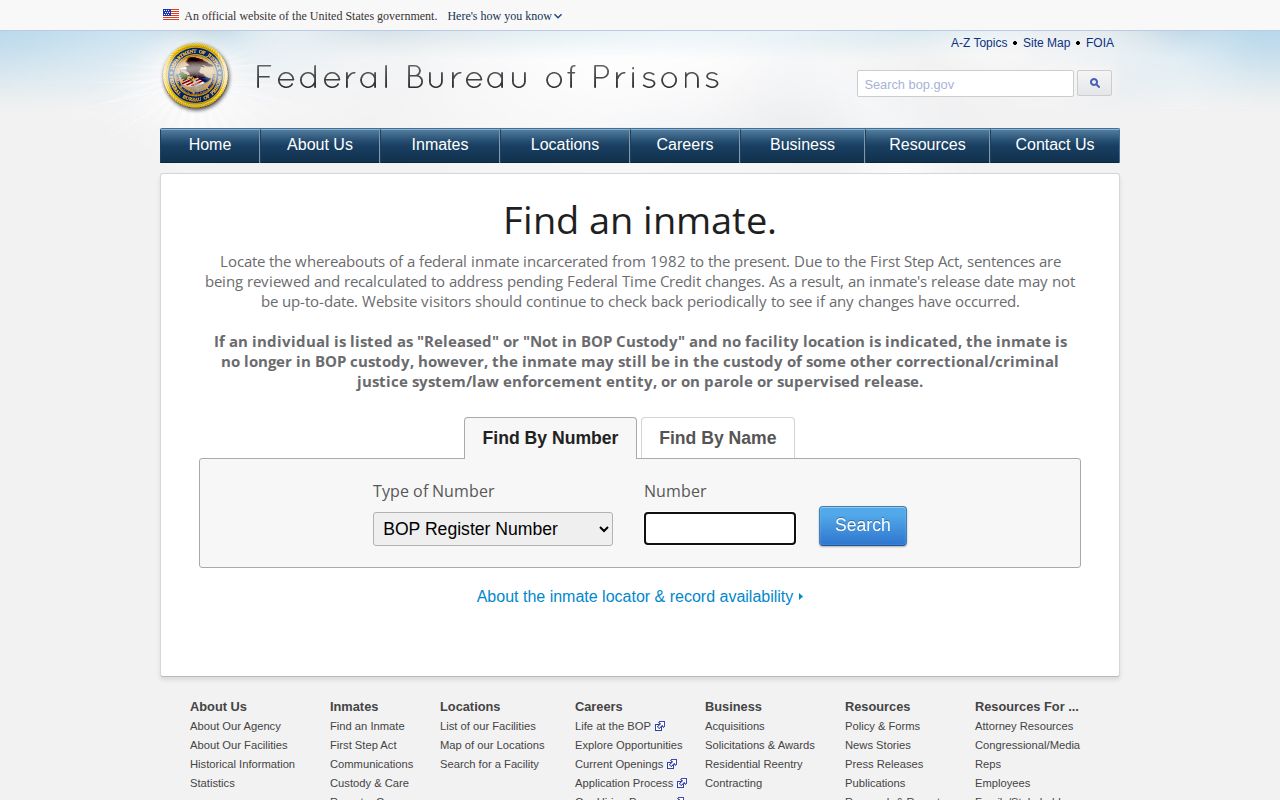
Never use a CT DOC no-result to infer the outcome of a federal case.
Compare New Haven County Custody Records
Each system answers a narrow question. Check the source that held or supervised the person, then corroborate a release with the next legal record.
- CT DOC search
- Shows current location and status; release fields or Public Information provide follow-up.
- State court docket
- Shows remand while held and bond, disposition, sentence, or probation after release.
- CT SAVIN/VINE
- Provides custody status and change alerts, but not a full disposition.
- Parole or probation
- Shows community supervision rather than jail custody.
- BOP locator
- Separates federal custody and former federal release dates from Connecticut records.
- ICE ODLS
- Locates current ICE detention; recent release may require confirmation from ICE or counsel.
New Haven County Release Facility History
The CT DOC New Haven Correctional Center profile says the center opened on April 27, 1976, on a 4.9-acre site. A dormitory followed in 1991, a parking garage in 1993, and an outside detail unit in 1997. The history helps explain why this state facility, rather than a county sheriff jail, anchors local pretrial custody questions.
The institution remains a level 4 correctional center with a largely pretrial role. Its function is different from Cheshire Correctional Institution's sentenced-prison role and from the two parole district offices. Search and release methods should follow those differences.
New Haven County Release Facilities
The Facility Map includes institutions, supervision offices, local holding systems, and separate federal and immigration paths. New Haven CC is the main pretrial center. Cheshire and Manson are state institutions. Bridgeport serves some New Haven County courts. The New Haven and Waterbury parole offices handle community supervision, while local police and court cells may release someone before CT DOC intake.
- New Haven Correctional Center: pretrial and court-driven releases.
- Cheshire Correctional Institution: sentenced state-prison releases.
- Manson Youth Institution: state custody with youth-record limits.
- Bridgeport Correctional Center: serves Ansonia, Derby, and Milford courts.
- Connecticut Parole and Community Services, New Haven District: post-release supervision.
Other New Haven County release paths begin with supervision, brief local holding, or a separate federal system:
- Connecticut Parole and Community Services, Waterbury District: Waterbury-area supervision.
- Local police lockups / courthouse cell blocks: short holds and direct court or police release.
- Federal Bureau of Prisons / District of Connecticut cases: federal releases.
- ICE custody: immigration detention and release.
Identify the custody type first. Official New Haven County release confirmation must come from the agency that created the record.
Note: Facility names identify a possible record custodian, but only matched identifiers and official status confirm a New Haven County release.